Punch Cards and Tabulating Machines
The punched card began life in a weaving loom, telling threads where to go. In the 1890s it learned a new job: telling a machine what numbers to count. Herman Hollerith's tabulating machines turned the American census from a ten-year slog into a job finished in weeks, and the company he founded became IBM — the giant that would dominate computing for the next century.
In short
Punch cards carried data as patterns of holes. Herman Hollerith's electric tabulating machine, built for the 1890 United States census, read the holes in cards mechanically and counted the results — finishing the count far faster than the 1880 census, which had taken nearly seven years by hand. Hollerith founded the Tabulating Machine Company in 1896; it later merged into the company renamed IBM in 1924.
From looms to ledgers
In 1801, the French weaver Joseph-Marie Jacquard built a loom controlled by a chain of punched cards. Each card's holes told the loom which threads to lift, so a complex pattern could be woven automatically, over and over, without a skilled weaver guiding every thread. Babbage saw the idea and borrowed it for his Analytical Engine, where cards would carry instructions. But the first practical use of punched cards in computing came from a different direction: not instructions, but data.
The census problem
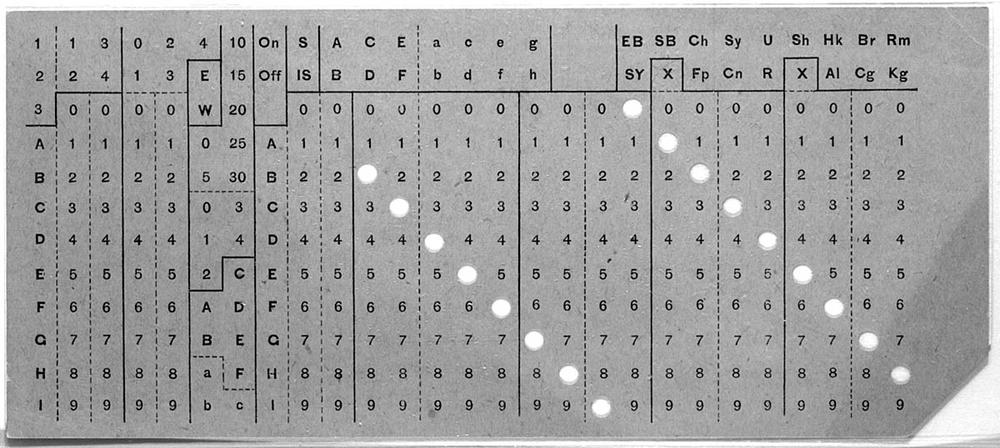
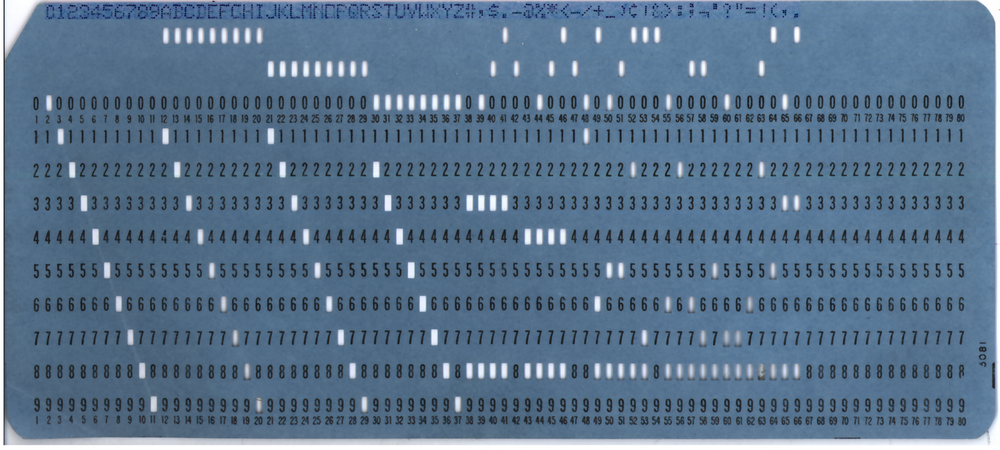
The United States Constitution requires a census every ten years. By 1880 the population had grown so large that counting it by hand took nearly seven years — and officials feared the 1890 count would take ten, longer than the gap between censuses. The Census Bureau offered a prize for a faster method, and Herman Hollerith, a young engineer who had worked on the 1880 census, won it. His machine read cards in which each person's details — age, sex, occupation — were recorded as punched holes. Pins pressed through the holes completed electric circuits, and dials counted the results. Each card could hold about eighty pieces of information, and the cards themselves were the stored data, ready to be sorted and counted again.
Weeks instead of years
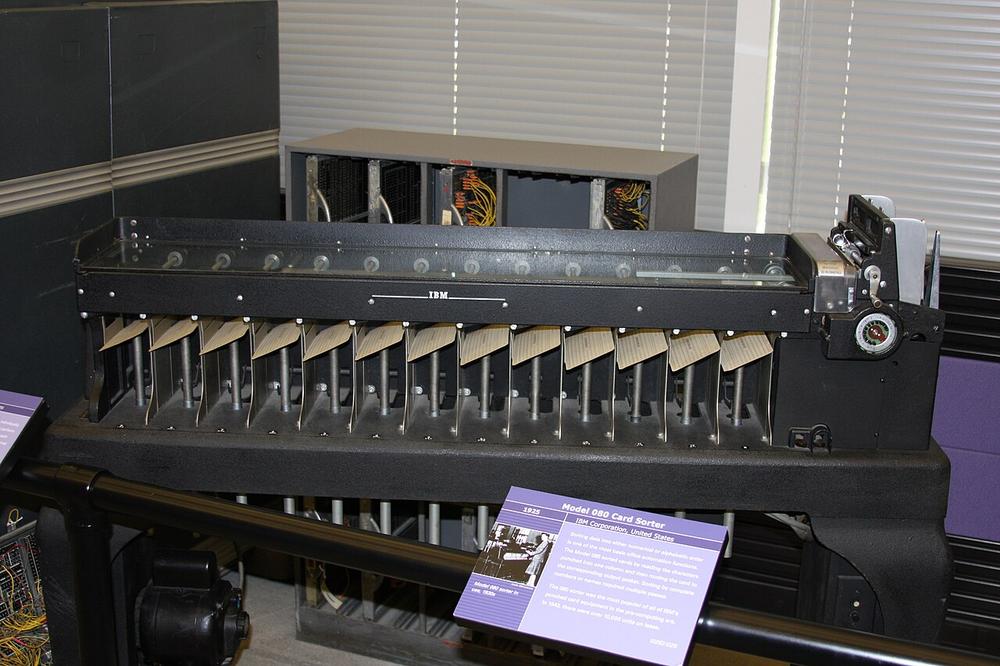
The 1890 census was tabulated in a fraction of the time of the 1880 count — the main results were ready in about six weeks of machine counting, against years of hand tallying before, at a reported saving of about five million dollars. The success made punched cards the standard tool of business data processing for the next sixty years. Banks, insurers, and railways bought tabulating machines to count payrolls, bills, and tickets. Hollerith founded the Tabulating Machine Company in 1896; in 1911 it merged with two other firms to form the Computing-Tabulating-Recording Company, which in 1924 was renamed International Business Machines — IBM.
Why punch cards matter
Punched cards taught computing two lasting lessons. First, data and instructions could both be stored as patterns of holes — the same idea, in electronic form, became the stored program. Second, counting could be a business: companies would pay for machines that processed information faster than clerks. Punch cards stayed in use into the 1970s — generations of students carried decks of cards to computer centres — and the 80-column card set the width of early computer screens and printers.
Sources: Herman Hollerith — Wikipedia, Punched card — Wikipedia, Jacquard loom — Wikipedia, Computer History Museum timeline Checked 27 November 2026.