Early Calculating Devices
Long before any machine could be called a computer, people counted on their fingers, on beads, and on gears. The abacus served merchants for thousands of years, and in the 1600s inventors in France and Germany built the first machines that could add and subtract on their own. Every computer since is a faster, smaller descendant of those bead frames and brass wheels.
In short
People have used calculating tools for thousands of years: the abacus, used across Asia and the Mediterranean, is the oldest still in use. The first mechanical calculator was Blaise Pascal's Pascaline, built in 1642 to help his tax-collector father add long columns of figures. Gottfried Wilhelm Leibniz improved on it in the 1670s with a machine that could also multiply and divide.
The abacus: beads that remember
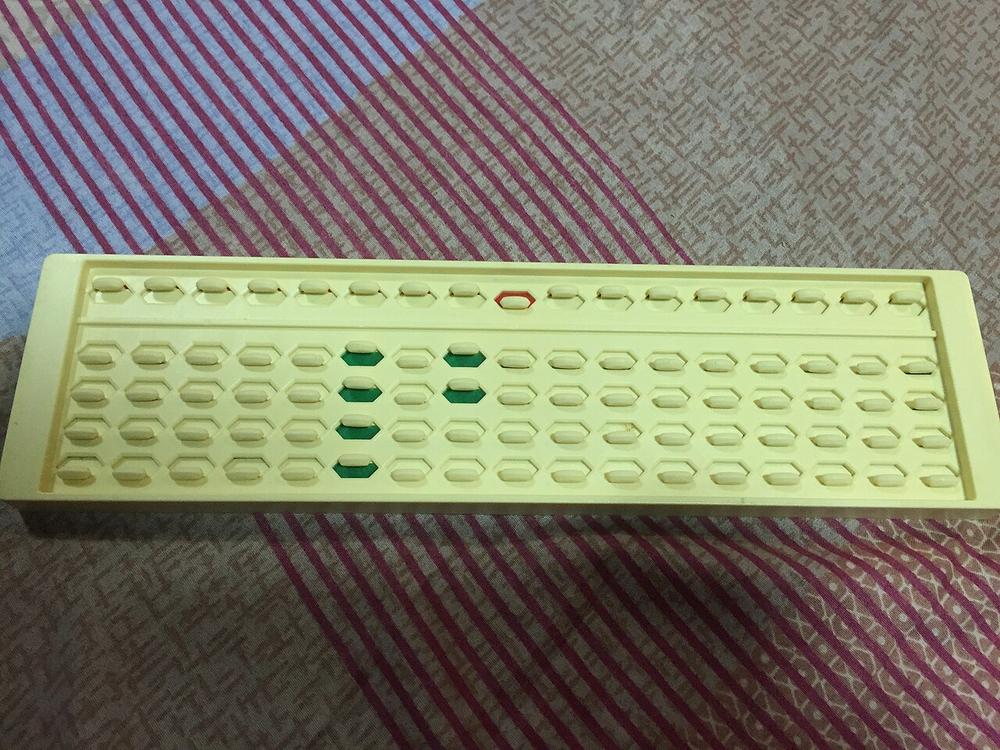
The abacus is a frame of rods with sliding beads, and it may be the oldest calculating tool still in everyday use. Early forms appeared in Mesopotamia and Egypt, and the bead frame spread through China, Japan, and across Europe, where merchants used it to add, subtract, multiply, and divide. A skilled user could calculate faster than a person with pen and paper, because the beads hold the numbers in place — the frame itself is the memory. The abacus is not a computer: it cannot follow instructions or make decisions. But it taught the basic idea that a physical object can stand in for a number, and that moving objects in a fixed pattern can do arithmetic.
Counting boards and tally sticks served the same purpose in other places. Roman merchants used a counting board with grooves and pebbles — the Latin word for a pebble, calculus, is where the word "calculate" comes from. These tools were slow and needed a human hand for every step, but they were reliable, cheap, and needed no power.
Pascal's machine, 1642
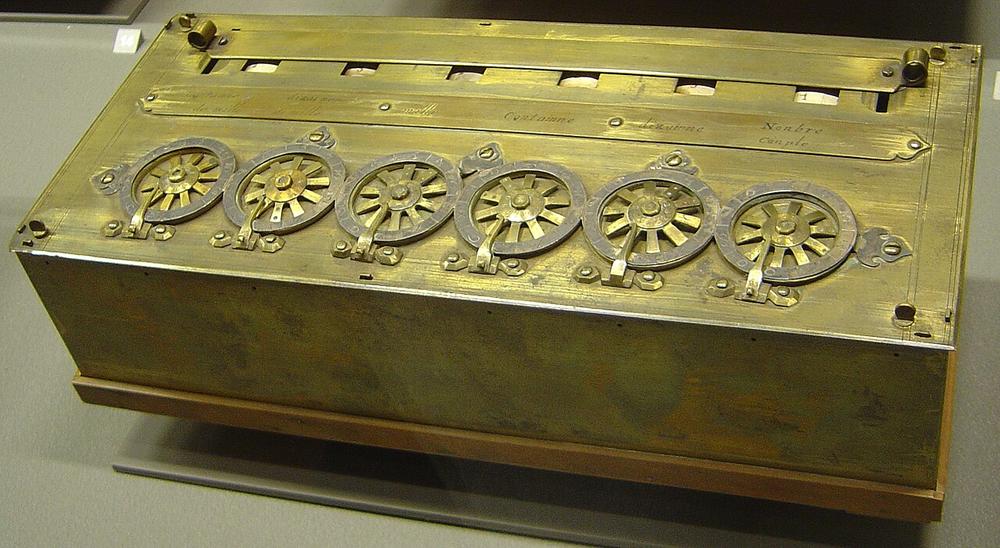
In 1642, the nineteen-year-old French mathematician Blaise Pascal built a brass box of gears and dials to help his father, a tax collector in Rouen, add up long columns of tax figures. The machine, later called the Pascaline, could add and subtract numbers up to eight figures long. Turn a dial ten notches and the next dial moved one place — the same carrying-over that children learn in school, done by gears instead of by hand. Pascal built about fifty of them, but they were expensive, hard to make accurately, and few people bought them. The idea, though, survived: a machine could do arithmetic by itself.
Leibniz and the stepped reckoner
In the 1670s, the German philosopher and mathematician Gottfried Wilhelm Leibniz designed a machine that went further. His stepped reckoner used a special toothed drum — the Leibniz wheel — and could multiply and divide as well as add and subtract, by repeating addition. Leibniz also dreamed bigger than a calculator: he imagined a machine that could reason with symbols, and he worked on binary arithmetic, the system of ones and zeros that every modern computer uses. His machine was never a commercial success either, but the stepped-drum design was copied for two hundred years, and in 1820 the Thomas arithmometer became the first mass-produced calculator.
What these machines could not do
None of these devices could follow a program. Each calculation needed a human to turn the dials, read the result, and decide what to do next. They had no memory beyond the position of their gears, and they could not change their own behaviour. The jump from calculator to computer — a machine that follows instructions on its own — would need two more ideas: punched cards to carry the instructions, and a design, like Babbage's Analytical Engine, that could branch and loop. Both are the subject of the next guides.
Sources: Abacus — Wikipedia, Pascal's calculator — Wikipedia, Stepped reckoner — Wikipedia, Computer History Museum timeline Checked 27 November 2026.